Eight Glass Products Built for Mérida OEM/ODM Programs
Each item below can be produced on a low iron base where the drawing does not already specify a technical substrate. Drawings, print colours, coating sides and annual volumes are reviewed before a quotation is issued — no catalogue-price guessing.
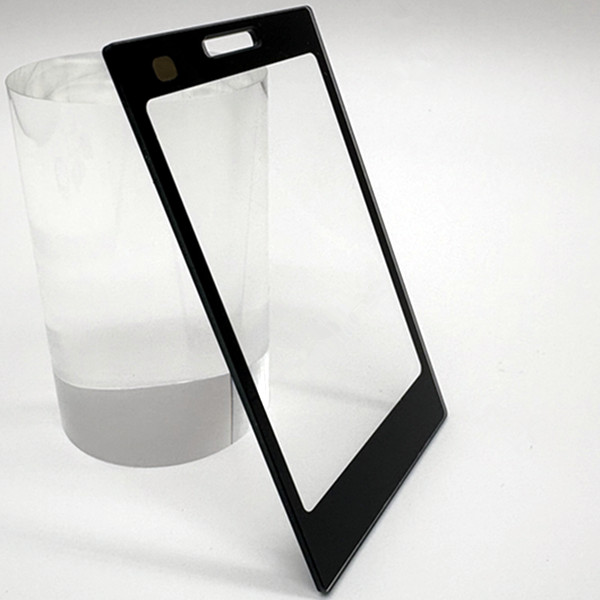
Factory Customized Black Glass Panel Silk Screen for Display Touch Electronic Glass
A 1.1–4 mm low iron panel with an opaque black print and an optional infrared-transparent window, so capacitive and proximity sensors sit behind the glass without a visible cut-out. Edges are ground before strengthening to remove micro-chips that later become cracks.
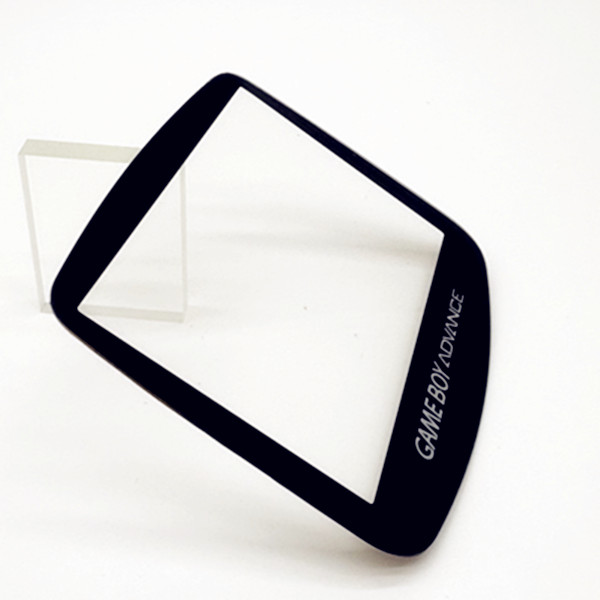
Custom Premium Gorilla Tempered Silk Screen Printed Glass Panels Cover Glass for OLED Screen
Alkali-aluminosilicate cover glass, chemically strengthened by ion exchange and then printed for OLED and LCD modules. Print sits on the second surface where optical bonding or the housing protects it, and the user-facing side can carry AR or anti-fingerprint coating.
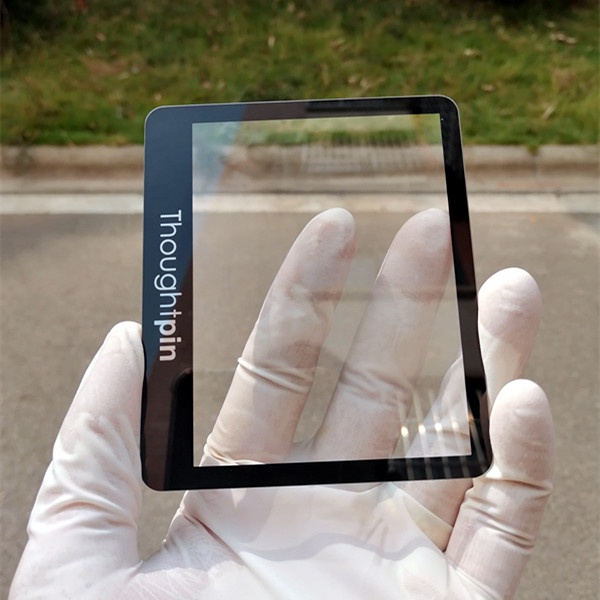
1.5mm 2mm Tempered Glass Thickness Touch Switch Glass Plate
Capacitive switch plates in 1.5 mm and 2 mm where the glass is both the interface and the front-panel decoration. Thin gauges are normally chemically strengthened rather than thermally tempered — below 3 mm, thermal tempering is difficult to control and affects flatness. Low iron base keeps backlit icons neutral.
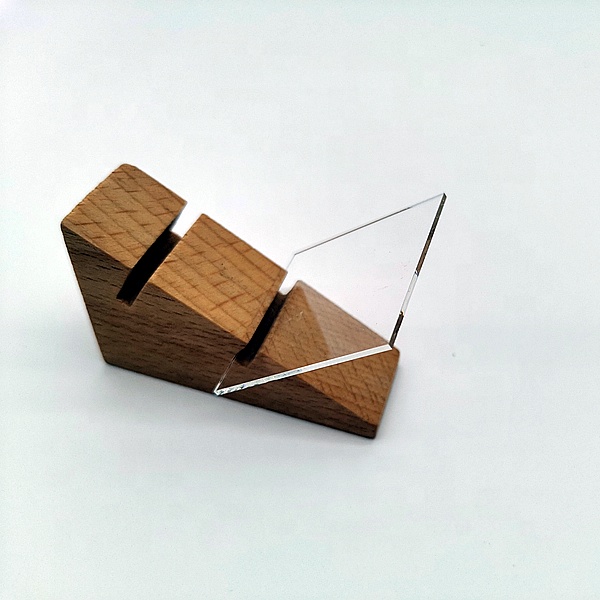
Custom 0.2mm 0.3mm 0.4mm 0.5mm 0.7mm 1mm Alkali Free Borosilicate AF32 Glass
Alkali-free aluminoborosilicate in 0.2–1.1 mm for OLED encapsulation, sensor windows, high-temperature carriers and thin-film processes where sodium migration damages the device. Low thermal expansion and strong chemical durability, cut and edge-ground to drawing.

Custom Shape High Transmittance Ultra Clear Tempered Glass Panel With Anti-reflective Coating on Two Sides
Low iron glass coated on both faces, reducing each surface reflection to roughly 0.5% or better and lifting peak transmission towards 98%. The stack is tuned to the customer’s wavelength band rather than sold as a generic coating, and can be combined with a printed border or AF top layer.
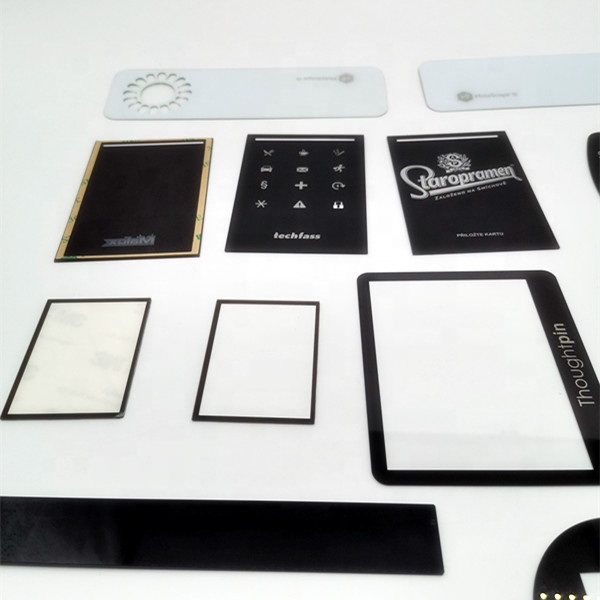
Custom Display Screen Silk Screen Printing Tempered Gorilla Glass
Multi-colour silk-screen printed, tempered display glass for control panels, appliances and industrial HMI. Dead-front black, icon windows, gradient masks and laser-etched symbols are aligned to the drawing; print is cured and inspected for pinholes before packing.

Factory Customization Dichroic Glass Gobo Glass
Borosilicate gobo and dichroic blanks from 0.2 mm to 2 mm for stage, architectural and themed lighting. The low-expansion base tolerates heat from high-power fixtures while the dichroic coating separates colour without gel filters. Custom patterns and orientation marks available from small runs.
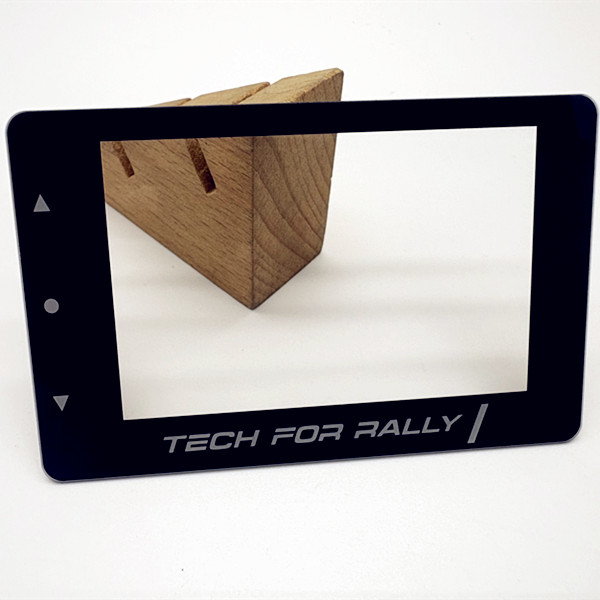
Customize Tempered Glass Silk Printed Ar Coating Gorila Glass LCD Screen protection Display
A triple-process cover: low iron or Gorilla®-type substrate, silk-print border, double-sided AR and chemical strengthening. Built for outdoor kiosks, LCD windows and retail signage where sunlight, fingerprints and cleaning chemicals all attack the surface. Add AF or anti-shatter film for public installations.
Why Low Iron Glass Wins in Mérida’s OEM/ODM Supply Chains
Mérida is not a glass town, and that is exactly why it matters. Yucatán’s capital has become a manufacturing and commercial hub for appliances, electronics, automotive interiors, LED lighting, food processing, medical services, hospitality and retail. Companies here do not buy glass by the tonne; they buy a component that must arrive with a drawing number, a tolerance stack, a print colour and a coating specification attached.
Low iron glass — also sold as ultra-clear, water-white or low-iron float — is defined by its iron oxide content. Standard clear float carries roughly 0.05–0.10% Fe₂O₃; low iron glass is refined to about 0.015% or less. The visual result is easy to see: a 5 mm low iron sheet transmits around 91–92% of visible light on an ISO 9050 basis, against roughly 88–90% for ordinary clear float, and its edge reads neutral instead of green. For printed cover glass, AR-coated display windows and colour-critical lighting, that difference is not cosmetic — it decides whether a white appliance panel looks white and whether a brand colour survives the coating stack.
Mérida’s climate adds a second layer. Relative humidity commonly runs 70–90%, UV index can reach 10–12, and salt-laden air moves inland from Progreso, 36 km to the north. A supplier that only quotes a glass size will miss the failure modes that actually matter: coating adhesion after damp heat, ink yellowing under UV, edge chipping that becomes a crack in transit, and condensation inside a display stack. Our specification reviews therefore start with the application environment, not the price per square metre.
It is worth correcting a common assumption. Low iron glass is not a solar-control product. It raises visible transmission and slightly reduces absorption, but its solar heat gain coefficient remains high. Where Mérida projects face a SHGC target — large shopfronts, hotel atria, glazed offices — low iron glass should be paired with Low-E coating, solar-control film or external shading. Using ultra-clear glass alone and expecting a cooler building is a specification error, and we will say so before an order is placed.
The commercial argument is equally practical. Low iron base glass costs more per square metre than standard clear, but it improves yield on downstream processes. A printer gets a neutral background for colour matching. A coater gets a substrate that does not absorb part of the light it is trying to pass. An OEM gets a finished panel that reads cleanly beside premium appliances or in a hotel lobby. For Mérida buyers balancing landed cost against brand risk, that is usually the deciding factor.
Because Mérida is a component-assembly market rather than a glass-processing market, buyers here also need documentation discipline: material certificates, coating-side records, print colour references, dimensional reports and Spanish-language technical files for the importer of record. A low price from a trader who cannot supply those documents becomes expensive at the customs broker’s desk or on the first quality claim.
Visible Light Transmission at 5 mm Nominal
Typical comparison, same measured basis
Typical values for preliminary comparison, measured per ISO 9050 or ASTM E903. Coating performance depends on the wavelength band, stack design and substrate. Final values are confirmed on the approved sample and the glassmaker’s datasheet.
Where Low Iron Glass Performs in Mérida and Across Yucatán
Six application clusters that repeat in Mérida enquiries — each with different optical, mechanical and documentation requirements.
Appliance & Smart-Home HMI
Black-printed low iron panels and 1.5–2 mm touch plates for refrigeration, laundry and kitchen controls. Backlit icons stay neutral, IR-transparent windows hide sensors, and the flat glass surface wipes clean in humid kitchens — a practical advantage over mechanical switch clusters.
Automotive Interior & Trim
Dashboard trim, display covers and decorative panels for Yucatán’s automotive interior supply chain. Typical builds use 2 mm chemically strengthened low iron glass with AG or AR coating, UV-stable print and optical bonding plus anti-shatter film where passenger safety standards apply.
Hospitality & Retail Lighting
Centro Histórico hotels, Paseo de Montejo boutiques and resort projects use ultra-clear diffusers, light-box faces and gobo blanks. Low iron glass keeps LED colour temperature consistent, while dichroic gobo blanks tolerate fixture heat and produce saturated colour without gel fading.
Commercial Refrigeration
Display-case doors and shelf dividers for supermarkets, convenience stores and food exporters. Tempered low iron glass reduces the green tint that makes meat and produce look dull, while AR coating lowers reflections from overhead lighting. Anti-fog heaters or Low-E options are specified where condensation is severe.
Medical, Lab & Biotechnology
Analyzer windows, biochip substrates and instrument covers using Corning® Eagle XG, borosilicate 3.3 or AF32-type alkali-free glass. These substrates are selected for low fluorescence, dimensional stability and chemical durability through repeated cleaning and autoclave cycles rather than for decorative clarity alone.
Outdoor Kiosks & Signage
Tourist information kiosks, bus shelters and retail signage face UV, salt air and heavy seasonal rain. A practical stack is 2–3 mm chemically strengthened low iron glass, double-sided AR, AF top coat, UV-stable print and a sealed edge. For high-vandal sites, add a sacrificial anti-shatter film.
Four Trends Reshaping Glass Sourcing for Mérida Buyers
These are the shifts we see in quotations, samples and repeat orders — not abstract industry forecasts.
Shorter Replenishment Cycles
As North American assembly shifts toward Mexico, Mérida buyers are asked to hold less inventory while promising faster line changes. That favours suppliers who can hold tooling, repeat a colour match and ship scheduled releases rather than one large annual container.
Progreso as the Gateway
The Port of Progreso sits about 36 km from Mérida, with feeder and transshipment routings that typically put Asia–Yucatán sea transit at 30–45 days. Packing must survive that humidity window, and documents must be ready before the vessel sails — not after arrival.
NOM Files and Spanish Documents
Importers increasingly ask for Spanish datasheets, commercial-information labels and technical files aligned with NOM-024-SCFI-2013 or NOM-003-SCFI-2014 where applicable. Manufacturers using IMMEX or PROSEC programmes also need clean HS classification and consistent invoice descriptions.
Premium Clarity, Not Just Durability
Hotel, retail and appliance brands now treat the glass as a visible design surface. Ultra-clear edges, neutral colour and anti-reflective coatings are requested alongside scratch resistance — and buyers are asking for AG or AF finishes that survive commercial cleaning chemicals.
Low Iron Glass Compared with Adjacent Technical Substrates
Use this table for preliminary selection only. Final thickness, coating and strengthening route are confirmed against your drawing, the application environment and the glassmaker’s datasheet.
| Material | Typical thickness | Iron / key property | Visible transmission | Best fit in Mérida projects |
|---|---|---|---|---|
| Standard clear float | 2–12 mm | Fe₂O₃ ≈0.05–0.10% | ≈88–90% | General glazing, non-colour-critical covers |
| Low iron ultra-clear | 0.5–6 mm | Fe₂O₃ ≤0.015% | ≈91–92% | Printed appliance panels, display windows, light boxes |
| Low iron + double AR | 0.5–6 mm | Reflection reduced both sides | up to ≈98% peak | Sunlight-readable displays, museum and hospitality glazing |
| Gorilla®-type alkali-aluminosilicate | 0.4–2 mm | Ion-exchange strengthening | ≈91–92% | Scratch-resistant touch covers, automotive trim |
| Borosilicate 3.3 | 0.3–3.3 mm | CTE ≈3.3 × 10⁻⁶/K | ≈91% | Heat-resistant windows, gobo blanks, laboratory glass |
| Corning® Eagle XG / AF32-type | 0.2–1.1 mm | Alkali-free, low fluorescence | ≈91–92% | Biochips, analyzer filters, OLED and semiconductor carriers |
HS classification guidance for Mexican imports is typically 7006.00 for edge-worked or drilled glass and 7007.19 for toughened safety glass, depending on processing. Your customs broker remains the final authority; we supply the invoice description, material declaration and origin documents to support the entry.
A Glass Supplier Mérida Buyers Can Audit, Not Just Email
Fevry Glass Co., Ltd. is a specialty glass manufacturer based in Xinyu, Jiangxi, China. We process technical glass to drawing for optical, biological, semiconductor, communications, lighting and electronics customers, and we export to Western Europe, the United States, Japan, South Korea, Taiwan, Hong Kong and Southeast Asia.
Sourcing from China into Mexico is not only a price decision. It is a question of whether the supplier can trace the raw glass, repeat the coating run, hold a print colour across batches and provide documents your customs broker and quality team can accept. Our answer is a single, auditable chain: raw glass sourced from Corning, AGC, Chengdu Guangming and Xinhuguang, processed on laser, ultrasonic, CNC carving, grinding and inspection equipment imported from the United States, Germany and Japan, then packed for export under one roof.
That integration shortens the hand-off chain. Cutting, strengthening, coating, printing and inspection happen as one controlled workflow rather than five unrelated subcontracts, which is why dimension reports, coating-side records and print approvals can be issued against the same job number. Our operating principle — “Quality is superior, service is supreme, reputation is first” — and our motto “Your success, our glory” are not slogans for a brochure; they describe the decisions we make when a buyer’s tolerance is tight and the delivery date is fixed.
For Mérida OEM/ODM buyers, we also work as an extension of the engineering team. If you have a finished drawing, we quote against it. If you only have a housing, a display module and a target cost, we can propose a standard build — substrate, thickness, print stack, coating side and strengthening route — then send a sample for fit and optical validation before tooling is committed.
Laser, CNC & Ultrasonic Machining
Custom outlines, holes, notches and slots with flat, pencil or chamfered edges. Equipment imported from the USA, Germany and Japan.
Thermal & Chemical Strengthening
Thermal tempering for thicker panels; ion-exchange strengthening for 0.15–2 mm thin glass where flatness and optical clarity matter.
AR, Dichroic & Optical Coatings
Anti-reflective coating on one or both sides, dichroic mirrors and optical filters for lighting, imaging and instrument windows.
Silk-Screen Printing & Back Painting
Pantone-matched borders, logos, icon windows and IR-transparent ink areas, plus back-painted glass for LED and appliance panels.
Dimensional & Optical Inspection
Size, thickness, flatness and visual defect checks before packing, with inspection records issued against the job number.
Traceable Raw Glass
Material sourced from Corning, AGC, Chengdu Guangming and Xinhuguang, with certificates carried through to the finished part.
 Precision glass processing workshop, Xinyu, Jiangxi
 Imported cutting and grinding equipment
 Optical inspection and export packing
From Mérida Drawing to Cleared Shipment in Four Controlled Steps
A predictable route for procurement teams that need fewer surprises and an auditable decision trail.
Drawing & DFM Review
Send a DWG, DXF or PDF with outline, tolerances, glass material, edge finish, print colours, AR sides and annual volume. We reply with manufacturability notes and a firm specification.
Sample & Optical Validation
Pre-production samples validate fit, print registration, coating colour and transmission. Where required, damp-heat and adhesion checks are added before approval.
Production & Inspection
Mass production with in-process dimensional and visual checks. First-article and inspection reports are issued against the job number, with AQL sampling agreed at RFQ stage.
Export Packing & Shipping
Vacuum bags, desiccant, EPE foam, honeycomb boards and plywood crates for humid sea transit. EXW, FOB, CIF and DDP options are quoted with documents ready before sailing.
Questions Mérida Buyers Ask Before Placing a Glass Order
Direct answers to the technical, logistical and compliance questions that come up most often in Yucatán sourcing conversations.
What exactly is low iron glass, and how is it different from standard clear float?
Low iron glass is a float glass refined to remove most of the iron oxide that gives ordinary glass its green edge. Standard clear float contains roughly 0.05–0.10% Fe₂O₃; low iron grades are typically at or below 0.015%. On a 5 mm sheet, that lifts visible light transmission from around 88–90% to about 91–92%, and the edge appears neutral rather than green. For printed panels and AR-coated displays, the benefit is colour accuracy and a cleaner optical base.
Can you supply OEM and ODM glass to a plant in Mérida, Yucatán?
Yes. We work from drawings or from a housing and display module when no drawing exists yet. For Mexican manufacturers, we prepare commercial invoices, packing lists, material declarations and technical datasheets, and we can provide Spanish-language product information for the importer of record. If your company operates under IMMEX or PROSEC, tell us at RFQ stage so the invoice description and HS classification are aligned with your programme from the first shipment.
What are the lead times and shipping options to Mérida?
Samples usually take 7–10 working days after drawing approval, and mass production typically runs 15–25 working days depending on coating and print complexity. Sea freight from Shanghai or Ningbo to Progreso commonly takes 30–45 days port-to-port with transshipment, while air express is about 5–7 days door-to-door. We quote EXW, FOB, CIF and DDP where a reliable broker is available; for inland delivery to Mérida, confirm Carta Porte requirements with your transporter.
What MOQ applies to low iron cover glass and printed panels?
Most custom cover glass, printed panels and AR-coated parts start at 300–500 pieces, custom-cut Eagle XG parts at around 1,000 pieces, and selected gobo or dichroic blanks from as few as 10 pieces. MOQ depends on the process route rather than the glass area alone: a new print colour or a new coating run carries setup that a 50-piece order cannot absorb. Samples can be arranged before a mass-production commitment.
How do you protect glass from humidity and salt air during sea freight?
Export packing is built for the Gulf humidity window: each part is interleaved, vacuum-bagged where appropriate, and packed with desiccant in EPE foam and honeycomb board before closing into a plywood crate. Edges receive particular attention because a chipped edge becomes a crack under vibration. For coastal projects, we also discuss edge sealing and coating durability, since salt air affects coated and printed surfaces more than the bulk glass itself.
Which documents and certificates come with each shipment?
Standard documentation includes the commercial invoice, packing list, certificate of origin, material certificate from the glassmaker, dimensional and visual inspection report, and RoHS or REACH declarations where relevant. If your quality system requires first-article inspection reports, PPAP-style documentation or specific dimensional layouts, raise it at RFQ stage so the inspection plan is built before production rather than reconstructed afterwards.
Do you support NOM compliance and Spanish-language labelling?
We can supply Spanish-language technical data, material declarations and label content to support your importer’s compliance file. Whether NOM-024-SCFI-2013, NOM-003-SCFI-2014 or NOM-008-ENER-2001 applies depends on the final product and its use, and the importer of record remains responsible for the conformity assessment. We provide the technical inputs your certification body or customs broker requests, and we flag missing information before shipment.
What do you need to quote a Mérida OEM/ODM project quickly?
Send a 2D drawing in DWG, DXF or PDF with outline dimensions and tolerances, thickness, glass material, edge finish, hole and notch positions, strengthening method, print colours with Pantone references, AR coating sides, the application environment and expected annual volume. If you do not have a drawing, send the housing dimensions, display module, target thickness and a photo of the installation. Complete inputs typically allow a firm recommendation and quotation in one round.
Request the Low Iron Glass Catalog for Your Mérida Project
Send your drawing, target thickness, print colours and annual volume. Our engineering team reviews the specification, confirms the right substrate and returns a quotation with samples, lead time and shipping options to Progreso or Mérida.
Typical enquiry response: within 4 working hours. Samples available before mass production.